

Quantum Ogre
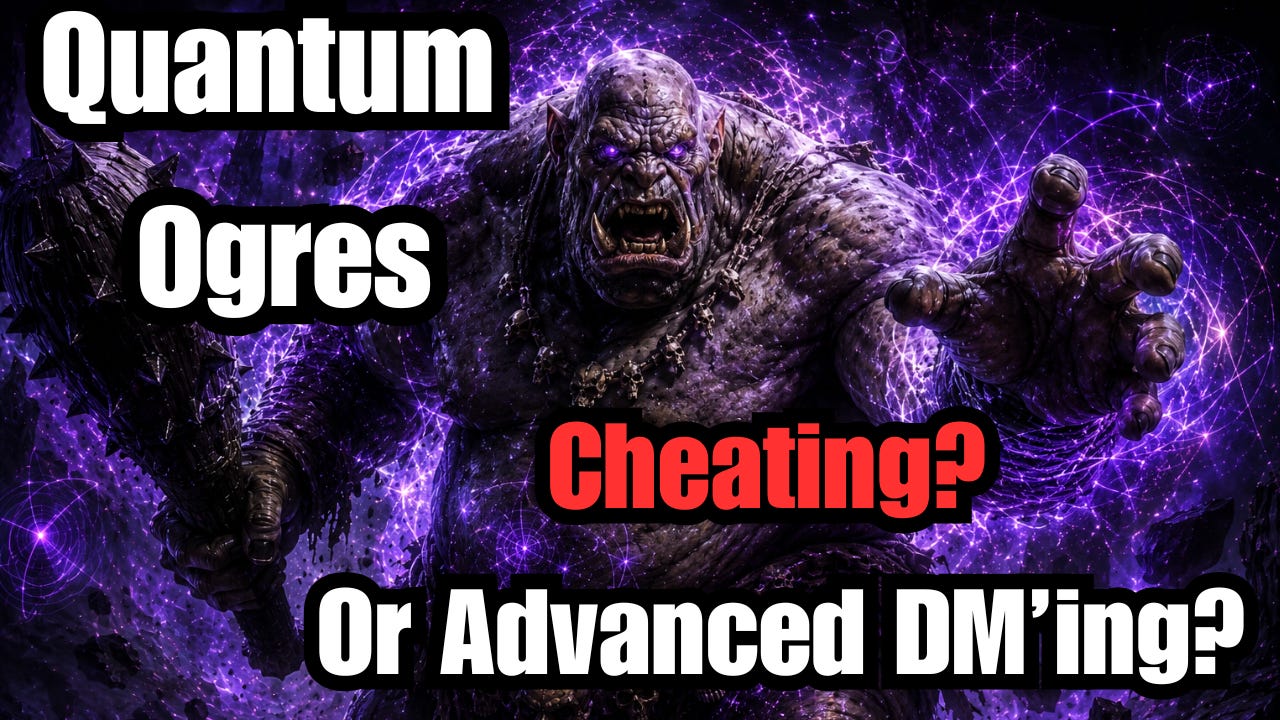
The Quantum Ogre discussion arose back in the blogger days of the OSR. There was a discussion about sandbox play and the freewill of players and player agency. In response to a post by Beedo on Dreams in the Lich House, Courtney Campbell of the Hack and Slash blog wrote a post on how illusions can rob your game of fun. The illusion he’s talking about is the illusion of choice.
Here’s where the ogre comes in. The players come to a branch in the trail. They can go in three different directions. Which one do they take? Doesn’t matter. What matters is that the GM will have them fight an ogre no matter where they end up going. The adventure is basically a railroad. Their choice was meaningless. But was it?
It depends on the nature of the choice. In this case, there were three options. Did the players have any information about the fork in the road? Did they know that the left fork lead to Ogreville, and the right to Goblinville and the middle path lead to Orcville? If that’s the case then having the ogre appear no matter what choice they made is robbing them of agency, especially if they wanted to go a route that was less dangerous.
If, however, they did no investigation and had no knowledge upon which to base their decision, then it doesn’t make a difference what route they took. The ogre can be anywhere. Their agency is not impeded in any way.
Another way to look at it is whether it was a meaningless encounter or one that matters to the adventure. A good analogy here is from the TV series The X-Files. They had two types of episodes: the MOTW episodes, which stands for Monster of the Week, and the ones that drove the overall mystery plotline of the series forward. I look at RPG’s the same way. If it’s a throwaway encounter just there for XP and loot, and for some filler before they get to the next important thing that’s related to the overall adventure, then who cares where it is or if you go all QO with it. It literally doesn’t matter. If it’s an encounter that does relate to the overall adventure, let’s say it’s an ogre with an important clue the PC’s need to move forward, then it does matter. It means that no matter what decision the players make as to where to go they will get the chance to kill the ogre and get the clue. That’s the definition of a railroad.
Some say that the best solution to avoid the QO issue is to roll every encounter on random tables as they occur. I don’t like this approach. In my experience, rolling up random encounters on the spot doesn’t give the players the best experience. If the table has three choices, either 6 goblins, 3 orcs, or 1 ogre, and the encounter is a MOTW type encounter, then all you’re really doing when you throw it at them on the spot is rolling a surprise check, rolling a reaction check for the monsters, and see inf if there’s a fight or not. If it’s a fight, then it will not be that interesting because you didn’t have the time to make it interesting because you just rolled it up.
I like to make up my encounters ahead of time. If I’m using roll20 or if in person I’m using a battlemap, I lay out where the enemies are, where the PC’s will be when it’s triggered, and add interesting things to the field of battle which could make a difference in the combat. Lookout posts, quicksand, boulders and trees to hide behind, a hole in the ground that leads to a lair that reserves might jump out of…there’s a million things you can do to make the combat situation more interesting. Some people call this heresy, but really, the only difference between rolling them ahead of time versus rolling them on the spot is that if done ahead of time you make them better.
If you roll them ahead of time, and they’re just MOTW type encounters, and you put them on the path no matter which way they go, then who cares? No agency is lost because the decision to take one particular path was done in a vacuum. If that was the players’ fault because they didn’t ask questions, then it’s on them. Like I said, that should change what you place there. Goblins would be on the road leading to Goblinville, etc. But if you as a GM made it impossible to get any info ahead of time, then you’re railroading them with the QO.
Another variation on this I’ve experienced as a GM is where the encounter is more than just a basic bullshit ogre on the road or goblin ambush. For example, I made up a large cave complex where a clan of goblins lived, and they were raiding the halfling lands around. The PC’s had a choice to go there, or to orc caves, or a couple more places. They went to the orc caves, kicked their asses. Through roleplaying later, the halfling village they saved said they’d take care of the goblins, thanks for the help. The goblin caves went unused. It would be a bullshit move as a GM to have the PC’s encounter the goblin caves in the next encounter. But there’s nothing wrong with using it in the future. I reskinned it a bit, added a two-headed troll, and used it as an encounter with a different group. I could have used it with the same group once enough time had passed, and it was in a different place.
Bottom line, I’m not against the QO thing, as long as it’s used as a MOTW encounter and it’s not used as a way to railroad the players.
https://hackslashmaster.blogspot.com/2011/09/on-how-illusion-can-rob-your-game-of.html
https://dreamsinthelichhouse.blogspot.com/2011/09/shell-game-in-sandbox.html
You are making yourself responsible for the outcome of this encounter in a way that you wouldn't be if you rolled on a random table or filled out the world and left it to player choice.
Consider: you build an encounter for the ogre. They will face it no matter what. You've miscalculated the party's strength - for whatever reason (maybe someone doesn't show, maybe someone leaves mid-session, maybe they're hurt from another encounter, etc.) - and the ogre kills some or all of them.
This is because of a choice that you made that the players had no way of avoiding. They can say, "The DM killed us" because it's true. You chose to put that ogre there, no one else.
If you had rolled on a wandering monster table, it would have been the game that killed them.
If you had placed the ogre there before hand and the players chose to travel that way, it would have been the world that killed them.
Do your players never double back?
Also, what was the point of giving the players a zero information choice? In a well designed dungeon, you don't necessarily need to telegraph every intersection because it is a small space, and learning its geography of the place is part of the point; that is, information about the dungeon is received as a result of choosing a path and taking it. The path itself provides information to the players.
But with overland travel, unless you are doing a hexcrawl or a dungeon-like pointcrawl, un-telegraphed choices don't tell the players anything. So what do you think your players are getting out of having that choice? If they have no information, they have no agency. The choice isn't meaningful, and the players assume no responsibility for encountering the ogre because their decision was entirely random. It did not happen as a result of a *meaningful* choice, and subconsciously they probably know it. I've been in games like that, and I definitely knew it. At some point you're like, "Whatever man, I go right," because you know you have no control over the situation.
So IMO you have a problem before you even get to the ogre. From the players' point of view, there was never anything they could have done to avoid the encounter, because there was no information they could have used to choose any differently, it was just a coin toss.
And sure, you can recycle unused material, reskinned or not, but the choices leading the players to the encounter also need to be telegraphed in some way. The recycling is not the problem. The lack of player agency is the problem. Fundamentally, the problem with the quantum ogre isn't so with moving encounters around, as it is with not providing players with what they need to have a semblance of control over their characters' destiny.